Friday, 23 September 2022

How a 600ah lithium battery setup has changed my motorhome full-timing life.

But let me be honest from the beginning - very few people will actually need 600ah. I was actually planning 300ah, which was a meaningful upgrade from my original 200ah lead acid setup. But at the last minute a friend who was advising me said that for what it will cost - all other installation costs being the same, an extra £600 to double the capacity was, on paper, a bargain. Furthermore he said that he had found, with that much power on tap, that there were many more intangible benefits that would crawl out of the lithium woodwork. And he was right!

Background - my wife and I full time in our S700 in all seasons. We are also heavy power users. TV and laptop are on most days, most of the time. Our daily power use varies but averages about 75ah a day. Our original fully charged 220ah  lead acid battery, backed up with 500w of solar, would, in winter, just manage a full weekend off grid, with no engine charging or EHU. In summer we had power to spare, and could stay off grid almost indefinitely. But for full timers, it is winter performance that matters.

In winter, our routine was always different to our summer routine. In winter we needed to drive more, and plug in more, which meant using camp sites or visiting friends more often, or even occasionally running a generator. We never liked using it, but occasionally - maybe twice a year, it was a life saver.

Of course there is also the point to be made that you can always use less power - this is a valid point, and we can and do switch things off if we want to stay put for longer and eke out the battery, but it's no fun.

This last system, we ran for about 5 years, and it taught us a lot about energy use in a motorhome. We discovered 3 things. 1. accurate monitoring is essential - you need to know what you have and what you have left - same a the van fuel gauge. 2. No matter what, every amp you take out, has to be put back in. 3. Solar power is by far the most important part of any off-grid system.

1. Monitoring I have blogged about elesewhere. It's important. But I would add that in the context of lithium batteries, you usually get it for free - in an app, and this has proved to be a real benefit.

2. This sounds self evident, but is really important! In summer, a decent solar system will put in the next day all you took out the night before. But in winter, solar panels give a fraction of what they do in summer, so you have to monitor very carefully and plan your activities to put back in power from other sources.

3. Solar power is the only free source of power, and the only one you can be truly off-grid. So in a nutshell, you need to fit as much as your roof will hold.

The reason I make these 3 points is that having a huge battery is not the simple answer to all these problems. But what it does do, is give you options.

One example of this is that with 600ah on tap - whereas before we would have to move after 3 days - now we can stay for much longer. If we use 200ah over a weekend, we still have 400ah left. However we soon learned that if we do stay in one place and use say 90% of a 600ah capacity, then we really need a proper recharge. Winter sun would take weeks to recharge that much, so the reality has proved that if we do need 500ah of recharge, the only meaningful option is to plug in. So our EHU charger has to be capable of completely refilling a 600ah batter in an overnight charger - this basically means 10 to 12 hours at 50a. So another rule we have learned about big lithium, is that your EHU charge source needs to be big enough to recharge in less that 12 hours - ie overnight.

The same goes for alternator charging. A lithium battery will suck in every amp that you throw at it, so a 60a alternator will deliver exactly that, for long periods of time, and will eventually overheat. There are various ways to improve this - we chose to install a B2B - battery to battery charger. This is a unit that sits between the engine battery and the lithium battery, and limits the power that can be transferred. In our case this is 60a - half the capacity of our 120a upgraded alternator. A side effect of this is that with a 60a b2b, 2 hours of driving actually gives us 120a. This is quite different to our old lead acid battery, which would suck in high power for a short while, and then settle down to a fraction of that - so a 2 hour drive would give something like 30a of charge, even though 60a was theoretically available. This is quite technical, and down to the difference in charging characteristics of lead acid and lithium, but this is a noticeable example.

This also a good example of how fitting a lithium battery means that you also have to think about, and if necessary modify, your charging equipment. Lithium batts have different charging characteristics to lead acid batteries. In our case this proved to be a good thing, because as already mentioned in the past, especially in winter, we had to plan our movements carefully, especially with regard to the weather, and driving distance - now we have a decent B2B, we can drive less for the same power, or get more power from the same drive. So when we are just touring around, distance between stops can be less, saving diesel. It also means that with a 50a EHU charger, we can take advantage of even short stops where EHU is available - ie at friends etc.

But by far and away the biggest advantage for us has been simply the fact of having all that power on tap. We no longer have to move because we have to - we move because we want to. We can stay a week or more instead of just a weekend, and if we do, and use almost all of that 600ah - then we know that all we need is an overnight charge, and we are good to go again. In pure financial terms, with campsites and CLs costing around £15 these days, in winter we are saving around £60 a month. 


There have also been some minor advantages, but satisfying nevertheless. We now run our fridge on 220v while driving - this keeps it cooler. And in summer we run it on 220v quite often, even though it is a 3-way fridge and takes 10amps. This is saving us gas - LPG, and we have already noticed that we are using less gas. I have always defended 3-way fridges because they are the ultimate in versatility, and they are. Our 3-way is quite new, so no intentions of throwing it out for a compressor fridge, but if the situation arose, I would now have no problem handling a compressor fridge, even in winter.

Another advantage is the use of high power items. My old system was easily capable of delivering the 100a or so needed to run a toaster or coffee machine for a few minutes, and on paper, because they were only on for a few minutes - eg 100a for 5 mins = 8.3ah - not a lot. But over the months I soon noticed that regular high power use was changing the characteristics of my lead acid battery. I looked into the technicalities of this, and learned that the capacity (and long life) of a lead acid battery depends entirely on the type of discharge it is asked to perform. It will last longer with only light discharge, and shorter with heavy discharge. And because I have accurate monitoring, and am a bit of a geek, it didn't take me long to realise that these morning coffee and toaster sessions were affecting the battery noticeably. 10 minutes of breakfast use was taking much longer to recharge from solar than the numbers would suggest. So after a year or so, we stopped, and went back to gas for toast and coffee. No such problem with lithium - they are quite linear. Doesn't matter if you take out 100a in 1 hour or 1a in 100 hours - the result is the same. So although the basic rule of put back in what you take out still applies, there is no worry about affecting the life of the battery.

Don't forget what I said above - these are minor advantages, but I have enjoyed discovering them and experimenting. 

So do you need 600ah?? Probably not is the honest answer. But several of us full timers have, and nobody yet is regretting the extra cost. 300ah is probably a meaningful upgrade for most van livers upgrading from 100 or 200ah lead acid systems. My system is now 6 months old and I have yet to go below 300ah, but I know it's there, and I expect to be using it for the rest of my van life - 10 to 20 years - which is another good reason to go lithium - long life.

There are 2 ways to get lithium. DIY or ready made. I chose the DIY route. The DIY route involves buying the individual 3.2v Lifepo4 lithium battery cells, and connecting them together, in a case or frame of your own construction, to the power and voltage you want. So in my case I used 8 x 3.2v 300ah cells, in a 4 series 2 parallel configuration, giving 600ah at 13v. The mechanics and connections was a relatively easy DIY job. A lithium battery consisting of multiple cells needs a circuit board called a BMS - Battery Management System. This is a board that sits between the cells and the outside world. It has multiple functions - it balances the cells, and protects them from over and under discharge and voltage. It is an essential part of the system. Good BMS also have bluetooth built in and come with an app. That is all the technical detail I will go into at this point. But anybody with a multimeter, who knows how to use it, has hooked up batteries and stuff before, and is willing to read online from the many excellent DIY websites and forums - is capable.

The non DIY route is to buy from an established battery manufacturer. These companies do what I have just described above, but in a much more user friendly way - ie they put the 4 cells and the BMS inside a box that looks and feels like a traditional 12v battery. These can usually, but not always, be straight swap replacements for old 12v lead acid batteries - but you should check with the supplier. You also get UK based support backup and warranty. A typical example in the UK is Roamer batteries, who consistently get good reviews. But the cost difference is about 50 to 100% over DIY, because you have to pay their profit margin, which is well deserved!

Lastly - order cells directly from China at your peril. BMSs are usually OK, but ordering small quantities of lithium cells can be a nightmare from China, using Alibaba etc. Just take my word for it, and don't be tempted by what appear to be really cheap prices in dollars - that is only the beginning of it. Contact me more more details.


Wednesday, 7 September 2022

MERCEDES OM602 FAN BELT FIT

 This engine is found in most Merc S class classics - late 80s to 1995. I am not sure if the same arrangement is found on earlier or later engines.

I have now had to be recovered in my S700 4 times in 23 years, and 3 of those were for broken fanbelts. 1 was random, 2 a coincidence but 3 is definitely a pattern. It is probably a service item and should be changed every 50k or so - I don't know, I don't have that info. But the reason it rarely gets done is that it is an absolute pig of a job. I know this to be true because I have been witness to the grunting and swearing that has emanated from the garages I have used, plus the posts I have seen on other groups.
So if you have a Mercedes, take note of this post, which will be in the index, for future reference.
All the difficulty stems from releasing the tensioning roller in order to slip on the new belt - at first glance there seems to be no way of doing it.
The first thing I discovered is that most of the online information, and in particular the Russek manual, is either wrong, or at the best, ambiguous. The diagram in the Russek manual is accurate in the general layout, but lacking in detail. After the event, I managed to find much more accurate diags - see below.
The procedure is as follows. Identify where is the tensioning spring, which runs parallel with the hydraulic damping cylinder. Here you find a nut (3 - yellow arrow) which is located on a bolt, which appears to be attaching the top loop of the spring to the bracket. This nut has to be taken off - but if you try, the whole thing just spins. What you can't see, and what isn't explained clearly is that there is a hex bolt head at the other end of the bolt (6 - red arrow) - but where is it? It isn't obvious. The bolt is actually a 3 inch long bolt that goes into a hole in the top corner of the engine block - the hole is about 3 inches deep, and the head of the bolt is back there - you have to reach your fingers in to feel it, and you can just get a spanner on it. One you do, then the front nut removes easily.
Then you have to insert a bar/lever into the recess in the top of the spring bracket - this is depicted in the diag with arrows showing the direction to push. This bar has to be provided by you. By moving this bar to the left or right you can move the spring bracket, release the spring tension, and then using a drift (anything handy) you can then push the bolt back through the bracket and into its hole - you can also help it out with your fingers round the back - but don't take it out completely - just enough so that it no longer fixes the top spring bracket in place. Once this is released, the spring will lose tension, and the tension pulley will fall down a couple of inches, finally allowing enough slack to get the belt around all the various pulleys. It is still a tough job, but it will go on.
The blue arrow indicates the actual pivot point of the bracket - for info only, it has no function in the job.
It is also worth mentioning that there are 2 ways to approach the job - access is really tight, and that is half the problem - you need a good set of tools to get at that nut and bolt. But if you take the radiator off, the job is a whole lot easier. Taking the rad off is a 20 minute job. If you are doing this job yourself, and are not pushed for time, and maybe doing other work, consider removing the rad.
Once it is on, you have to re-tension the spring and then lock it back in place, under tension. To do this, you have to push your bar, which is still in its hole, well over to the left, which will pivot the top spring bracket anticlockwise, until the point where the holes in the bracket and the engine block align, and you can push the bolt forward, through the holes, and the spring is then tensioned and locked in place. Replace the nut, and that's it, job done. When you know what you are doing, and you have just the right sized bar, it's a 5 minute job. If you don't, then it's a frustrating episode with much swearing and skinned muscles.
The confusion arises from the fact that removing the nut is counter intuitive because you think that is what is holding the spring in place. It is and it isn't - the spring is held in place by a collar in the bracket, and the bolt slides through the middle to lock it in place. the actual pivot point of the racket is further down.
I just had to pay a French garage 2 hours labour because they had no clue, despite me presenting them with photos from my collection, and the Russek manual. In the end what saved us was a telephone call to my own mechanic friend in N Wales.
None of this will make the slightest sense to anybody! It doesn't apply to Fiat family owners, and it is of no interest to Merc owners, until it happens to you - at which point, this detailed description should be useful to you or your garage.
I am also now reasonably convinced that in motorhome use, Merc fanbelts have roughly a 5 to 8 year lifespan - probably nearer 5, especially if you have modified electrics, like I do - ie big batteries. In motorhome use, the alternator works harder and hotter and so does the belt. The belt can get damaged slightly if the engine is turned off when the alternator is hot, and the belt can get slightly "cooked" at that point. The alternator pulley is the smallest on the belt, and therefore is working hardest. My intention now is to make sure I have a new belt either every time other work is carried out at the front, or every 4 or 5 years.


Saturday, 7 May 2022

Fridge not working on 12v or leisure battery not being charged while driving - how to troubleshoot. The D+ line explained.

This article is about pre 95 vans - with the old style fuse panel, and no Electroblock (EBL). However if you do have a later van with EBL, there is useful info here so it's worth a read. See note at end about EBL.

Fridge not working on 12v while driving is quite a common fault - usually a bad connection caused by old age and corrosion. It is closely related to another fault - leisure battery not charging while driving. 

How it works.

There is a red cable that leads from the positive of the engine battery (EB) to the Hymer fuse box. On most vans there is a big inline blade fuse of 20 or 30amps and although this is not famous for blowing, it can happen, so it needs to be located and checked before anything else.

This red cable then leads to the 2 relays in the fuse box. These relays only operate when the engine is on, so that the flow of power from the engine battery and alternator only works when the engine is on. The relays are operated by a wire from the alternator known as the D+ wire. When the engine is running, the alternator is spinning, the D+ wire goes up to 12v, and this operates the coils in the relays, which close the relay contacts, allowing the power to flow through the relays to both the leisure battery (LB) and the fridge. When the engine is switched off, the 12v on the D+ wire goes off, the relay coil relaxes, the contacts open, and the power is disconnected. This ensures that the EB is disconnected from the LB and fridge when the engine is not on, ensuring that the EB can not go flat, even if the LB does. It is a fundamental feature of all motorhome electrics - also called "split charge relay" - the charge is split between the EB and LB, but only when the engine is on.

The D+ wire which operates the relays, also operates the ignition light on the dashboard - in a normal, non motorhome commercial van, this is part of the original Fiat or Merc wiring.  In order to make the D+ wire operate the additional relays for motorhome use, it was necessary for Hymer to "tap into" this wire. To do this they added an additional yellow D+ wire extension of their own, connected to the original D+ wire, and leading to the Hymer fuse box where the relays are located. Where Hymer tapped into this wire - see photos - can corrode with age - a flickering red ignition light is also an indication.

This is a general description - the principle is always the same, but there are differences between Fiats and Mercs, and different models and different ages. But all vans share the 2 common basics - the thicker red wire from the EB+, and the thin yellow D+ wire to the relays. All you have to do is locate them in your particular van.

In Fiat family vans, the EB is located under the bonnet. The red battery cable has to run right across the engine compartment to the other side, where the Hymer fuse box is located, usually by the drivers left knee (on a LHD van).

In Mercs, both the EB and the LB are located in the battery box by the side of the drivers seat.

In both vans, the wiring colours are always the same - red cable leads from the EB+, to the fuse box, through the relays, and back to the LB+ in a black cable. There is also a brown cable to the LB- negative. Do not get the cable colours mixed up! Brown is negative in Hymer 12v electrics.

Troubleshooting

The first test is easy - you need to know if it is all working or not. Disconnect the black cable from the LB+. With the multimeter set to DC volts, place the black meter probe on the negative post of the battery - ie ground - and hold the red meter probe on the end of the black cable. There should be around 13v there with the engine running, and nothing with the engine off. If you have 13v here with engine on, then everything in the charging, relay and D+ side is working, and the problem is elsewhere. If there is no 13v here with engine on, then see below.

If you are troubleshooting fridge not working on 12v, then the test for that is to locate the fridge fuse this is the first fuse below the fuses that are all connected by the copper bar - the top 3 or 4 fuses - it varies from van to van. But the next one down is the fridge fuse - so it's either fuse 4 or 5. Again, with the black probe on the battery negative, and the red probe on fuse 4/5, you should see 12v with engine on, nothing with engine off. If you have no 13v here with engine on, but you have 13v with engine on on the main black wire to LB+, then that means it can only be the fridge relay - the smaller one of the two.

If you have no 13v at these two points with engine on, then the problem lies either with the main red cable, the D+ wire, or the relays. The relays are the least likely cause, they rarely fail.

So the next thing to do is to expose the inside of the fuse box, to do this undo the 4 screws in the surround, and work the box forward - it can be awkward, there are a couple of screws protruding that you can't see which try and prevent the box coming fully out, but if you work the box up and down, it will come, and there is enough slack in the cables at the back - because that's how it went in in the factory.

Once you have the box out, and can see the relays, then the next test is also simple. Get your ear close to the relays, and rest your fingers gently on the relays, then start the engine - there should be an audible click and vibration of the relays operating - relays are switches, and they make an audible click. If you hear and feel this, then that proves the relays are working. If the relays are working, then the problem then must be in the main red cable feed from the EB+. This is rarely a problem in Mercs, because the cable run is short and inside the van, but in Fiats it has to run right across the engine compartment, through the bulkhead and into the back of the fuse box. So you need to locate this cable and check it. The usual culprit is an inline fuse which is either blown, or corroded. Failure of this fuse, its holder, and connections, are quite common in Fiats, rare in Mercs.

For those that don't know, this is what an inline spade fuse looks like - this is a generic pic from the internet, your will look similar, not exact, and may or may not have a cover.


But if the relays are clicking, but you have no 12v on the black wire to the LB+, or to the fridge, then the fault has to be between the EB+ and the relay.

If the relays do not click, then most likely you have a D+ problem, which is a break or bad connection in the thin yellow D+ wire. If you look closely in the box, you will see the yellow wire going to the socket of the big relay, and then an extension, also yellow, going to the socket of the small relay. If there is no 12v on the D+, the relays won't operate - they won't click.

In this photo you can see the yellow D+ wire going to the base of each relay.


As mentioned above, Hymer had to install an extension to the original D+ wire, running to the fuse box. On many vans they used a blue plastic connector called a scotchlock - also called Scotcklok, or snap connector. This is a connector that allows you to easily connect a new wire to an existing wire, without cutting.  

It is very difficult in just words to describe how these look, and work, so the best thing to do is to watch this Youtube. It shows exactly how they work.

https://www.youtube.com/watch?v=9U0N_BFHyaY&ab_channel=CURT

A typical example of the Scotclock D+ tap connection. Most pre 95 Fiat family vans are similar, but you have to root around to find it, and it might not be identical to this photo.


Unfortunately Hymer didn't know back in the 80s and 90s that these would corrode after 20 years and cause problems - but they do. So if you have no D+, you have to trace the yellow wire and look for this connection, because most likely it will be that - it's quite a common fault. The only problem is that with so many vans over so many years, not all vans have one, or it might have already been "fixed" by a previous owner. There is also a possibility that the fault is where the D+ wire is actually connected to the back of the alternator. I can't be more specific - it varies from van to van, but if your relays ain't clicking - it's that pesky yellow wire - somewhere!

If you do discover that the Scotchlock is your problem - then what do you do? The quick and dirty way is to snip all the wires - 3 ends - strip them back, twist together, and then seal with tape. This will get you going again, but will eventually fail after more years, depending on how well you did it, and how wet and damp it gets. Basically you can use any method that reliably re-connects the wires. Choc block connectors, Wago connectors, and 3m have upgraded the original to make it better - the new ones are round and better sealed. there is no one and only way - it's simple electrics - you just have to connect all 3 ends as best you can so that the power flows again.

As already mentioned - the relays are usually reliable and not faulty. But it is not unknown for them to fail. If you are sure that the feeds to the relay are present, but not getting through, then you have to remove the relay and test or replace. But you must be sure - relay failure is quite rare - it's usually always something else. Fortunately these are standard automotive relays, available everywhere. So you either borrow or buy a new relay, change it, and see if the problem is fixed. 

The relays can be hard to remove - work them out slowly by rocking side to side.

Or you can test the relay with a meter. To do this, you need to know how to use your meter to test continuity. All relays have the same pin numbers, which are marked on the relay - 85 86 87 and 30. Pins 87 and 30 are the relay solenoid coil. When 12v is applied to either of these pins, the other pin is permanently connected to ground through the socket, then 12v flows through the coil, which then creates magnetism in the coil, which then forces the other two pins 85 and 86 to be connected. So 85 and 86 should be open circuit when the relay is "off" and connected together with the relay "on". So how do you test this with the relay in your hand? The easy way is to get a PP9 battery - the small rectangular 9v battery that you can buy anywhere - and touch the battery terminals to pins 87 and 30 - the relay should click. If it doesn't, the relay is broken. If you know how to use the meter to test continuity - it's too long winded to explain this here because there are so many different meters - then pins 85 and 86 should be open circuit when off, and closed circuit when on. But 9 times out of 10, if you don't get a click with the battery, you don't need to go to the trouble of testing continuity with the meter - just replace it.

As with most things - there is a Youtube - this short Youtube shows exactly what I am trying explain with words!

https://www.youtube.com/watch?v=UBpQJ1DRa9A&ab_channel=Wisdom

The big relay is the main split charge relay that allows engine power to the LB - the original is a 70 amp relay. This is quite a rare size - it doesn't really need to be replaced with a 70 amp relay, it's a typical case of Hymer belt and braces - they used a big relay value so that it lasts a long time because it isn't working so hard. In normal use the relay rarely passes more than 20 amps. So if you can't get a 70 amp, any value above 40 amp will do. The smaller fridge relay is usually 20 amp and the fridge takes around 10 amps on 12v.

The original relays usually had metal covers - modern ones are usually black plastic - either will do.


So now we have explained how the power is connected from the EB to the LB and fridge, through the relays, and how the relays operate. 

So the only thing left to explain is what to do if you have a working relay system, and you have 12/13v on fuse 4/5 with the engine running, but the fridge is still not working. Well in this case, the problem must be with the fridge. The 2 commonest reasons for this are corroded connections at the fridge end of the 12v supply wire from the fuse box, or the actual fridge switch itself. Just look at this photo - that's how bad corrosion can be. Remove the bottom external vent to the fridge, and check behind there, looking for a connection like this, using the flat plastic covered spade connectors. That is how most classic Hymer fridges are connected to the 12v supply from the fuse box. In this photo the 12v from the fuse box will arrive here, but go no further!


Don't forget - Hymer 12v electrics - blue is positive, brown is negative.

The next most likely cause is the fridge 12v switch itself. These switches don't get much use and spend long periods in storage, unused. Over the years the contacts inside the switch can get corroded. So one trick is to work the switch many times - on and off until your finger hurts. You might get lucky and the fridge switch comes back to life. If you are lucky, sometimes you can pull the switch forward and there is just enough slack in the wires to get at the back of the switch for further tests, or even replacement - but it varies from van to van, as I have often frustratingly found out.

Unfortunately if none of this works, further checks and tests mean getting access to the fridge, and unfortunately this means the fridge has to come out so you can get at things. 

The 12v element in the fridge is quite famous for not lasting more than about 30 years. But to get at it - you need to take out the fridge. The element is a simple heater element - if it breaks, it will show open circuit with a meter. There are Youtubes and other online explainers on this.

EBL vans. 

If you have a later van with an EBL, then here are some notes to help you. On these vans, the relays are inside the EBL, and the main red EB+ feed and D+ yellow wire go into the EBL and the 12v feed from the EBL to the fridge is also there and easy to test. Although you can't get at the relays without going inside the EBL, you can troubleshoot, because the connections are on the front of the EBL, and you can shove the needle of your meter probe into the back of the plugs to take readings. There are different EBLs, but the diags and pin numbers are all online so all you have to do is find them. The D+ is quite easy because it is yellow. So the first thing to test on an EBL is that there is 12v on D+ with engine on. You should also be able to hear the relays if you are lucky. 

But all the above description about the feed from the EB and the way the D+ is tapped into, also apply to EBL vans, as do the comments about working on the fridge itself - the connections, switch and element etc.


HYMER CAMP NOTES

If you have a Hymer Camp, then all the above still applies, but you won't have the Hymer fuse box described above. In a Camp, the relays and habitation fuses are under the passenger seat, and the red cable main feed from the engine battery, and the D+ wire, lead here first, to the relays.


Thursday, 5 May 2022

The Classic Hymer meter panel - explained and maintained.

This article applies to pre 95 vans, with the classic fuse panel, and no Elektroblock. If you are unsure - ask on the group.


Most classics have a panel with 2 meters. One marked "Spannung" and the other "Strom". This is German for Voltage and Power. Next to the left meter, voltage, is a switch marked Battery 1 and Battery 2. It's a rocker switch. When you press either way, then the meter should light up, and the needle will indicate the voltage of the battery. Battery 1 is the VB, and should never change when you are parked up, and battery 2 is the LB, and this will very gradually reduce from over 12v to below 11v as you use the power from your LB. You will see that the dial is calibrated not only in volts, but in green and red zones! You should avoid running the battery into the red zone. In fact, by modern standards, the red zone starts a bit too low, you shouldn't really run a battery below 11.5 or 12v. But the old Hymer meters are not as accurate as modern digital ones, so there is a bit of leeway.

You can get some indication as to the health of your battery by looking at the voltage meter, but only when the battery is "resting" ie not being charged or discharged. So if you have solar, wait until night, and not on EHU. A fully charged battery will "rest" at 12.8v, around 13v, and will fall to around just under 12v as it discharges. So in the evening, when you are on battery power only, you can get an indication of how well your battery supplies your needs. If it regularly is at under 12v by bed time, perhaps after you have been using a TV or something else, then maybe it's time to look at your system - regularly discharging a 12v battery to 11v or 10v and below will shorten its life.

The right hand meter - Strom - has the needle always in the middle - known as "centre zero". Green zone to the right of the needle, and Red zone to the left. If the needle is in the red, then you are using power. If the needle is in the green, then the LB is receiving power by being charged. With the engine running, or on hookup (more on hookup later) then you should see the needle in the green. There is no control of this meter - it is for info only. But by looking at it when you switch things on and off, and comparing it with the voltage of Batt 2 (LB) you should over time get familiar with the power system in your van, and it is good for troubleshooting. It is calibrated in amps, but again, it is not very accurate by modern standards. The main thing is that it should deflect either way to indicate charge or discharge, but bear in mind that this will change according to the state of charge of the battery - if the battery is fully charged then don't expect to see the needle deflect much into the green, It will only do so if the battery needs and is receiving a big charge.

Also note that if you have solar panels fitted, the charge from these may not be indicated by the Strom meter. Solar panels were not a factory option and were often fitted direct to the battery, and not via the meter.

While you are hooked up to EHU, the voltage meter will be up above 13v all the time and the Strom meter will generally stay in the green all the time.

On the very left is a switch marked Frischwasser/Abwasser - this means Freshwater/Greywater and when pressed will indicate the level of either the fresh water tank, or the grey water tank. The lower part of the meter is calibrated "leer" 25% 50% and 75% and "voll". leer = empty, voll = full. It is not a continuous display. The level is not driven by a float as in a petrol tank on a car. There are 4 sensors in the tank, so the needle will jump between the 5 positions. It is only a rough guide. In old vans this system often gets clogged with dirt and stops working after many years.

In the middle of the panel you may see the  "switch with no name". This is an extra switch for options and/or owner fitted modifications. Yours may or may not do something. On many vans it has no function. Next to this is often a switch named "Lufter". That means fan, and operates the fan in the space above the cooker, to extract cooking smoke. There should be a lever under the panel which opens and shuts an external vent. 

On the right there is a usually a light switch called "Licht" which operates the kitchen light. On many vans there is also a switch by the entrance door for this light - similar to the two way switches that operate the landing light in a house.

On most classics, the whole control panel is secured by just 3 screws along the front lip and if you undo these the panel will drop down on hinges, exposing the gubbins inside. Many panels have a clock and/or a radio fitted - this is how you get at it. It also gets a bit dirty in there because of cooking, so you should have a gentle clean around every few years.

Troubleshooting

While the panel and meters are generally reliable - problems do occur, especially vans that have been stored outside for long periods.

Most panel problems are old age related - dirt and corrosion. The switches spend long periods not being used which over the years allows dirt and corrosion to build up inside the switch. So the first job to do is to work every switch hard - many times, on and off, until your finger hurts. While doing this, see if you get any action on the lights or meter. The same applies to the wiring connections on the back of the switches and meters. So you have to carefully pull, and then push back, all the spade connectors on the back of the switches and gauges - this moves the metal and cuts through any dirt and corrosion. Be careful - this is a delicate operation.

Then the next job is to make sure the bottom 3 fuses in the fuse panel are OK - these 3 fuses are the panel fuses. Don't just visually inspect them - remove and replace, same reason as before - possible dirt on the ends.

Further troubleshooting will probably need a multimeter and basic knowledge on how to test voltage and continuity.

Unfortunately Hymer never published a circuit diagram for the panel, presumably because it was made by a supplier - Schaudt, in Germany.

All you can do with the circuit board is to clean the connections as best you can. there is also a glass fuse on there, which I believe is a fuse for the panel illumination. This can also be cleaned and checked.


The bottom 3 fuses are the panel fuses.


Technical Background 

Switches


The switches are a standard switch and are readily available online, but you need to prove that the old switch is actually the problem. This needs basic knowledge and a meter. On all switches, the centre pins in the vertical plane, are the common pins. So this is where the supply is connected. The supply is then connected to either the lower or upper pins depending on the position of the switch. So to test a switch, you have to check for continuity between the centre pins and the upper and lower pins. The hymer switches are double gang - ie 2 switches in one. So each vertical row or 3 pins is a separate switch circuit. So, for example, on the battery selector switch, one set of pins is for switching the actual battery selection, and the other set is to supply voltage to the bulb in the meter, so it illuminates when you press. Some of the switches - the fan for example, only have a single function, so only one half of the switch is used. 

Meters

The meters are also still available, but very expensive - around €80£. So you have to be sure it's the meter, and not the feed to it.

If the strom meter is not in the centre and is hard over to one side or the other, then it is broken, usually caused by some incompetence or overload in the distant past. They are reliable and last for years if left alone, but break easily if mistakes are made.

The battery meter also doubles as a fresh and grey tank indicator.

Panel and Meter Upgrades

Although the panel and meters have a certain attractive retro chic - it can be difficult and expensive to fix and keep working, other than the basic cleaning and connection advice already given. The main information given by the panel is about power - voltage and amps. These days more than ever, you need to know how much power you are using, and have left. 

Digital displays were only just becoming normal in the 80s and 90s, but today they are normal - and cheap - and accurate. Accurate display of 12v voltage is actually very useful and important - you need accuracy to at least one decimal point, preferably two - there is a big difference between 12.2v and 12.8v - points of a volt are important. The original Hymer analog meter simply isn't accurate enough. So my general advice is that there is a place for a digital voltage display in a classic Hymer, regardless of whether the original is working or not. During the 90s, digital displays became standard on all motorhomes.

The same goes for the other meter - the famous "STROM" meter - strom is German for power. This meter should display amps - it is a centre zero meter, red and green. It measures, or rather estimates, the amps flowing into or out of the battery. There is a copper component called a shunt, located in the box behind the fuse panel, through which all power to and from the leisure battery flows. There is a cable from this shunt, through a fuse in the bottom 3 fuses of the fuse panel, that leads to the strom meter. When discharging - ie delivering power, the needle deflects into the red. When charging - ie receiving power, it deflects into the green. The meter is calibrated in amps, but again, suffers from the same problem as the volt meter - old technology and only accurate to about 20%. However this is not to be too critical of it, because its simple function of red and green tells you all you need to know at a glance - you need to know that the battery is charging when plugged in or the engine is on, and you also get a reasonable indication of how much power you are using - usually at night.

The other problem with the original strom meter is that it is difficult for it to display charging devices that have been added by owners and dealers - solar being the main example. In order for the charge from a solar panel to be indicated on the strom meter, it has to be correctly connected to the shunt in the fuse box, which involves removing the fuse box, and a difficult cosmetic cable installation. So as a result, most solar installs are connected directly to the leisure battery - it's easier. And many solar controllers have their own digital display, so although the strom needle doesn't work for solar, you can look at the solar display - assuming it has a display, and is visible.

So all of these issues lead to a general point about meter displays - you can do better! You can install a modern digital battery and power monitor display which is far more informative, and have change from £100. How to do this is covered in much more detail in another article which is linked below.

More info

Article on digital battery monitoring

https://hymers700.blogspot.com/2020/06/battery-management-for-classic-hymers.html

In depth article on the fuse panel and fuse box

https://hymers700.blogspot.com/2019/09/the-classic-hymer-fuse-panel-explained.html

Apuljack Engineering

This is a UK firm who will repair your panel if that's what you want. They also supply new meters - but be sure yours is actually broken.

http://www.apuljackengineering.co.uk/

Switches

The best switches are made by Marquardt, available from RS or CPC, also on Ebay and Amazon. Switch terminology can be cryptic - for example - 

"(On)Off(On) Momentary Large Black Rectangle Rocker Switch 6-Pin DPDT 12V"

I can't post links to suppliers because they soon become obsolete, so ask of the group if you are unsure.

https://www.facebook.com/groups/297054424534823


Monday, 31 January 2022

FRIDGES - 3-WAY (GAS) VS 12V COMPRESSOR

There seems to be a rumour going around that for some reason gas (3-way) fridges are both unreliable and/or "yesterday's technology". Nothing could be further from the truth. Gas refrigeration is by far the cheapest and most convenient way for normal van use, and the 3-way fridge is the ultimate in versatility.


It probably stems from the fact that "fridge not working on gas" is a common question - but what people seem to ignore is that this problem usually occurs after 20 years of solid service! Compare that with the life span of the average kitchen fridge.

Whenever somebody asks for advice about a gas fridge, you can always bet that someone else will advise to get rid of it and fit a 12v compressor fridge.

12v Compressor fridges exist because there are situations where gas isn't available - ie in many yachts. They are also getting more use in motorhomes because solar power has greatly increased in efficiency and price has come down. But they are still 12v only - no power, no fridge, so the 12v situation has to be constantly monitored, and even if the roof is covered with solar - there is still no escaping the weather, especially in the UK winter. However in the interest of balance I do agree that there are certain cases where a compressor fridge might make sense. An example of this would be where the owner has higher than average 12v system knowledge or perhaps the van is intended for use much further south - ie winters round the Med.

But spending between £1000 and £2000 for the fridge and possible 12v upgrades plus labour? Compared with fixing the original fridge that will cost between zero and a couple of hundred quid?

My contention is that if you possess a working 3-way fridge, there is absolutely no logical reason to rip it out in favour of a compressor fridge. Gas is cheap and plentiful - and always present - otherwise you would have no cooking or heating.

The 3-way system has been around for donkey's years and is as good today as it ever was. 220v when on EHU - 12v while driving and gas at all other times - always on, beer always cold.

Tuesday, 13 April 2021

Classic Hymers and the MOT test.

One of the common posts on the Classic Hymers Technical Facebook group is about MOT woes. Usually it's a photo of a long list of MOT defects that have resulted in failure. 

So here is my advice on how to minimise potential MOT pain.

I will start by being blunt (again!) - if your van fails it's MOT for any of the following reasons, then you are silly and have only yourself to blame. These are any lights not working, wipers or washers not working and horn not working. Seatbelts working and not chewed by the dog. These are the easy things to check, so at the very least all these things should be checked before your MOT. I know it sounds simple, but you will be amazed at who doesn't.

Next after this is tyres - there is really no excuse to fail an MOT on tyres when any branch of any of national tyre place companies will check your tyres for free.

So that's the easy stuff out of the way - but what about the hidden stuff that the average owner can't check?

My suggestion is as follows. Take your van to a garage you trust - hopefully you have one for your service work, and ask them to do a pre MOT inspection. If they refuse, then take it to a garage that will. But it is important that the garage is not also the MOT garage - they must be independent of each other. That doesn't mean to say that they don't know each other, just that they are independent. The main customers of MOT garages are other garages - they are in the trade together, so there is mutual respect.

It is well worth paying for this service because the inspecting garage will inspect everything that the MOT garage will inspect, but most importantly they will rectify as well. This means that the actual MOT should go without a hitch and just be a formality.

There is another huge benefit to this method, and that is that over the years you will get an excellent MOT record - all MOT history is now available online, and there is nothing worse to a prospective purchaser than a long list of MOT failures and advisories, especially for simple items like lights and CV boots - all it does is scream out - careless owner, couldn't be bothered.

You would be having to pay for the rectification of these faults anyway - so why let the MOT tester find them and enter them into the MOT computer system for all to see, forever. Far better to fix the faults before the MOT, and then, the test should just be a formality. This also removes the suspicion that a failure is being made to generate work for the garage. They are far less likely to try this when they know the van has been pre-mot'd by another garage.

However there are 2 parts of the test that might not be covered by this method, because the inspecting garage will most likely not possess two important pieces of equipment that the MOT garage has - these are the brake tester and the exhaust gas analyser.

But you should not worry too much about these - your brakes have to be really poor to fail the MOT, and a quick test drive to test your brakes should be all that is necessary. Do an emergency stop up some quiet road - you will know if there is anything wrong, and the van should stop in a straight line and not pull to either side. The handbrake will have been checked by the inspection garage - you don't need a machine to test a handbrake.

The exhaust test can be particularly stressful on an old diesel classic. There are two or three things you can do to give yourself the best chance. First - get the inspection mechanic to look at it himself and give his opinion. He is in the trade, and he knows his stuff. Second - make sure the engine is properly warmed up before the test. If possible, take it yourself and keep it ticking over for as long as possible before the test. Warm engines put out much less smoke. Thirdly, if you are really worried about the exhaust test, there are several diesel additives you can run through beforehand - again, your mechanic should be able to advise you. But generally speaking - if it passed last year, it should pass this year.

What I do is I combine my annual service at my trusted garage, with the MOT. The van goes up on the ramp, is fully inspected, brakes checked and adjusted, oil and fluids checked plus everything else on the MOT list. And then I pick it up and drive it to the same MOT centre I have used for the last few years, and it flies through, year after year. And anybody can go online with my reg, and all they will see is PASS PASS PASS.

That alone is well worth the extra money. Classics are not like modern cars - they are 20 to 40 years old, and the maintenance and inspection requirements are quite different to modern cars.

Of course I am not saying this is the only method for all owners - many owners do their own mechanical work - so this doesn't apply to you. But if you always use a garage for your maintenance work, and don't know much about maintenance and inspection, then using one garage for inspection, and another for the MOT itself, makes very good sense all round.

This is how the commercial truck world works - they never send a truck straight from the road to its MOT. It goes for service and inspection, and only then does it go for the MOT, where passing is usually just a formality, and it's straight back on the road again - time is money!

Monday, 8 March 2021

Solar Panels for Classic Hymers - new install, replacement or upgrade. (Updated 2024)

There have been a few questions on the Classic Hymers Technical FB group recently about solar panels, and it occurred to me that I haven't done a blog on the subject with specific reference to classic Hymers. This is not intended as a definitive right/wrong instruction manual for solar, just a general guide based on what I have picked up over the years from my own and other solar installs.

Most vans nowadays have some sort of solar installation. Many classics had them from new, or near new, and they were really expensive back in the 90s, but pretty much now most of those will be at least 25% or more down on performance. Technology has moved on - panels nowadays are around twice as efficient and at least 5 times or more cheaper than 90s technology. At the same time, the average need for power has gone up, with most owners nowadays wanting an evening's viewing of TV, a few hours of laptop, plus charging of all their devices - and all in addition to the normal requirement of lighting the van and running the pumps and fans.

The good news is that all this is possible, and more, with a basic single battery system, and a decent modern panel and controller. The aim of any solar system is to put back during the day, what you take out at night. If this is achieved, then a van can stay off-grid - ie no need to plug in or drive. This is of course dependent on the weather, but it is a perfectly reasonable expectation to have - at least in the summer months.

So let's look at what a typical modern system has to offer, in the context of a pre 95 classic Hymer motorhome. 

Let's first look at upgrades. My advice generally, if you have an existing system, especially one that you know to be over 20 years old, is to replace everything. The reasons are pretty much as already stated - technology has moved on and prices have fallen. The controller in an old system will be PWM (see below), the panel(s) will be very old and the wiring will also be suspect, and at the very least need checking. Of course, if you do have an old system, and it appears to be working OK, then don't fix it if it isn't broke - the true test of your electrical system is simple - does it ever disappoint you? If so, then it's time to do something about it.

Another good reason to upgrade to modern panels is that they perform so much better in low light. So if you use the van a lot in late winter, early spring and autumn, then you will benefit, as modern panels bring in more power when the sun is lower and weaker.

So let's assume that you have decided to either replace everything, or that you have nothing to begin with. So let's talk about the two main components of a solar system - the panels and the controller. The wiring and layout is quite simple - a solar panel sits on your roof - it has two wiring terminals on it - pos and neg. Two wires go from the panel to a controller, which is basically a box about the size of a normal battery charger, where they connect to two terminals that are clearly  marked pos (+) and neg (-) "panels" or a symbol that looks like a panel. The controller is mounted at a convenient place, usually on a wall close to the battery. Then two more wires lead from two similar terminals on the controller marked "battery", and go to the battery. That, for the very non technically minded, is the basic layout. It is very similar to how a battery charger plugs into the mains, and has two wires going to the battery - only in this case, the panel supplies the power, rather than the mains. All a solar controller is, is a sun powered battery charger.

There are other features - such as switches fuses and cable routing and waterproofing - but all these will be covered later.


Panels

So let's talk about panels. Panels come in many shapes and sizes, two different main technology types, and two formats.

The two formats are flexi and rigid. Rigid panels are the traditional type that you see on houses and offices. Flexi types are specifically for leisure vehicles - vans and yachts. Rigid panels are exactly that - rigid, so are difficult to fit on a curved surface. Flexi panels solve this problem nicely. There is quite an online debate about which is best. I have my own opinion, which is that rigid panels should be used where possible - ie if the roof is flat, or near flat. The reason is that rigid panels are cheaper, and they are easier to get off and replace if they go faulty. Flexi panels are more expensive, and if you are unlucky enough to have to replace one, they are really hard to remove. There is also another reason I like to give, and that is that rigid panels are produced by the millions, because they are used in big solar farms. Flexi panels are produced in the thousands, specifically for the leisure industry. Solar farms demand 25 year warranties, so are generally produced to high commercial standards. Generally speaking with regard to flat roofed classic Hymers - rigid are usually used.

While reading up on the latest in flexi panels, I came across this useful info about them - 

"
One decisive factor in determining the lifespan of Flexible Solar Panels would be the coating material. The two more popular types would be PET and ETFE. PET is a polyester-based plastic and ETFE is a fluorine-based polymer.  And, the main differentiating factors between the two would be strength, durability, and resistance to corrosion. While PET-laminated Flexible Solar Panels generally have lifespans of up to 5 years, ETFE – laminated Flexible Solar Panels have lifespans of up to 10 years." 

I have also seen ETFE advertised as PTFE, they are the same, or very similar.

Rigid Panels - The two different technologies are mono-crystalline and poly-crystalline. This refers to the type of silicone used in the actual cells. generally speaking mono is better and slightly more expensive, but these days it is less of an argument, especially when you are buying secondhand panels from suppliers like Bimble - see below.

Sizes are nowadays pretty standard - it is not an oversimplification to say that in general, with regard to van installations, there are only 2 basic sizes - big and small! Big panels are those used on solar farms. They are generally about 1750 x 900. Smaller panels are generally around 900 x 500. There were very few large panels around 30 years ago, so original solar installs on Hymers were usually always small panels. In terms of power - the larger panels are in the 300 to 400w range, and the smaller ones are around 100w. More on power below.

Fixing and brackets

Fixing panels to the roof. This is quite a hot topic that always attracts a lot of online discussion. The big debate is basically over screws vs adhesive. Nobody likes to drill holes in the roof of a cherished motorhome, so there is a strong case to be made for sticking them on and many advise this online. Flexible sealer adhesives have come a long way in the last few decades - silicone is a thing of the past - yesteryear's technology - but modern adhesives can literally stick the roof of your van to a crane, and support the weight. But only if chosen and used and prepared correctly.  And that is the problem for the DIY installer - no motorhome discussion group or forum is complete without at least one story of panels flying off on the M6, and just one story like this frightens people away from adhesive. Most horror stories are simply down to bad method or workmanship. Even professional installers can have bad days.

I believe that the best course for the amateur installer is screw and glue. There is no real disadvantage to having screws in the roof of a 30 year old van, and a modern panel installation at this age is likely to last the rest of the life of the van. There are also a couple of reasons for screw and glue that might not be apparent until you are up there for the first time. The first is that a screw will compress the adhesive nicely, forming a solid combined bond. The second is that a big panel can be  difficult to position with adhesive only - it can slide, and as it does it smears the adhesive. It's fine if you have access ladders and platforms and 2 assistants to help you lower a panel gently, but can be very difficult on your own while crawling on your knees on the roof. But if using screws and Z brackets, you can screw one corner down finger tight, without adhesive, and this will lock the panel in position. You can then go to the next corner and there is enough flex to lift up the corner and bracket, apply adhesive, and then let the panel drop is place in perfect position, then screw, and then onto the next corner, finally arriving back at the first corner where you can remove the screws, lift the corner, apply adhesive, and then drop and screw. This is a tried and tested method for fixing a large panel single handed. If using the long streamlined front brackets, then you do front then back, rather than corner to corner. But please note this method is suggested for big modern panels, which are hard to handle. if you are fitting small panels that you can simply pick up and place, then they are a lot easier.

The absolute number one rule about using adhesive is that the mating surfaces must be squeaky clean and totally free from dirt and grease. This means the section of roof where the bracket is to go, and the bracket itself. This doesn't have to be a complicated process, but you must take into account that the roof on a 30 year old van can have quite a tough layer of dirt and grime, baked on. A good scrub with laundry powder is a good method, followed by a thorough wipe off and then a final deep clean with solvent. All you need is a pack of cheap microfibre cloths and a bottle of solvent from the discount store. Solvent should be at least acetone quality - my friends in the trade use good old fashioned brake cleaning fluid. It works, and is cheap. Avoid solvents that have other chemicals added to them, or are less refined and oily - so turps and white spirit are to be avoided if possible. If you are a beginner, then a good course of action is to do a test. Stick two similar pieces together as a test, leave it overnight, and then try and separate. If you get it right, you will be amazed at just how strong it can be. 

As for screws, as well as the problem of water ingress and corrosion, usually 10 years down the line, there is also the problem that motorhome roofs are not exactly the best thing to screw into. There is a thin aluminium skin in the case of B class Hymers, and a reasonable thickness of fibreglass on S class Hymers. Under the skin there is stiff foam insulation. The whole thing is about 32mm thick, so you would never use a screw longer than 25mm. The trick with screws in the roof is not to overtighten. You want the threads of the screw to be fully interlocked with both the aluminium skin and the foam interior. The last thing you want is to apply too much force so that the threads strip and the screw continues to rotate - which it will very easily if you go at it hard with an electric impact driver. You are not screwing into wood or hard metal, where you want the screw torqued up to the max, you just want it to the point where you feel resistance, and the adhesive is just oozing nicely out of the edge.

Personally I use both at the same time - screws and adhesive. Not because I have less faith in one or the other, but simply because (for me) it makes for an easier installation. Screws have to be properly sealed, so I use the adhesive to both stick and seal. The screws I prefer are hex head stainless steel self drilling screws. These drill their own hole, so it is tight, and it is a single operation with a power drill. At the same time it forces the mating surfaces of the bracket to the roof, and seals everything. See photo.


Just the right amount of adhesive under the bracket, and when you tighten the screws it pushes out just right all round - sealed and stuck.

You can make your own brackets from aluminium angle, or you can buy commercial ones like in the photo.   You can also get really snazzy curved aluminium extrusion which also acts as an air deflector.

There are also plastic brackets available and these can be screwed or stuck on. Personally I don't like the big plastic brackets, and this opinion is shared by several professionals I have spoken to. All the instances I have seen of panels coming off have been using these plastic brackets. That is not to say problems don't occur with other methods, just that the plastic brackets seem to be more vulnerable to bad prep and installation. One reason put forward is that some plastic brackets have smooth shiny surfaces, and also possibly have residue of the releasing chemical used in the injection moulding manufacturing process. This, combined with bad surface prep seems to be responsible  for the majority of horror stories that are seen online. Another reason is that these plastic brackets are hollow - they only have a thin bevel round the edge in contact with the roof, plus many of them don't have screw holes.

But let me be clear about the whole bracket/screw/glue debate - there are plenty of vans out there with adhesive only plastic bracket panels on the roof. But the same goes for Z brackets, and I have yet to see a story about a screwed and glued Z bracket panel coming off. But the crux of the debate is surface prep ... the majority of horror stories have come down to bad prep, so the default advice has to be screw and glue, because the screws will act as your safeguard against bad prep.

As for screws only - there is no argument for screws only! You need to seal the screws against water ingress anyway, and sealer adhesive is the best way to do this. The only case for screws only is when the panel is attached to metal roof bars.


Also called spoiler mounts, and also available in ABS plastic

Plastic brackets - not my favourite, but can be used with care.
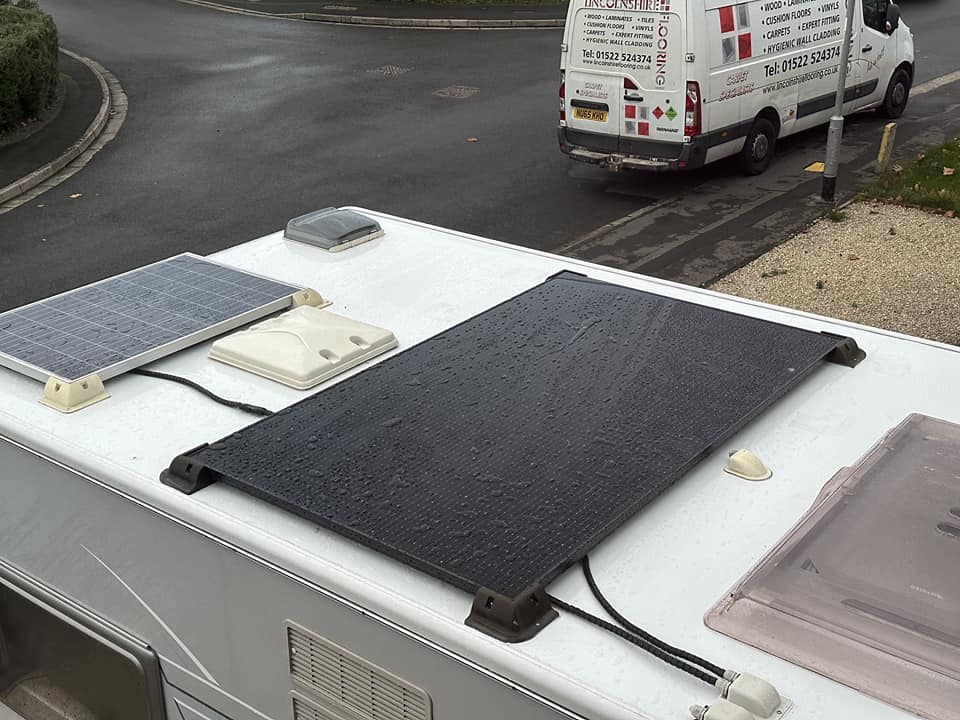

This is a nice example of plastic brackets glued and screwed (photo Mark Earles)


I generally prefer these aluminium Z brackets. They are versatile, low profile and easy to work with. I usually rough up the bonding surface with a bit of sandpaper.


Self drilling screw - you don't have to use hex head - any other head you prefer is fine. I just prefer hex head because there is almost no chance of the drill socket bit slipping off.  A variable torque drill on a low setting takes almost all the guesswork out. You don't want to over-drill, or over tighten screws into a thin roof. I usually use No 8 x 25mm (4.2mm x 25mm) stainless screws. However this is just my preference. Another option is to use stainless self tappers (ie not self drilling), with or without pilot hole. if you are confident with the cordless driver you can force a self tapper through the aluminium skin. or you can drill a 2mm pilot hole - just through the skin.

Which adhesive? I have only ever used one - Soudal Fixall Flexi. It is a flexible bonding sealer. It was recommended to me many years ago by Peter Curry who is one of the most knowledgeable classic Hymer engineers in the trade. I have never doubted the decision, and I always have a tube on the go in my van. It is general purpose. I seal windows with it, fix panels, make repairs - like most owners I hate drilling holes unless absolutely necessary - if I can stick it - I will. There are other makes - plenty of them. Sikaflex is the most famous name - but because of what I have just stated - I just don't know the various Sikaflex numbers. It's simply the fact that I have never used it. "Hybrid polymer Flexible sealer adhesive" are the key words to search for. CT1, as sold by Bimble is another example.  

On the subject of Sikaflex, I have noticed that there is a whole bunch of internet snobbery about Sika. Every time somebody asks any question about sealer adhesive, several answers will come up like "only use Sika 123", or 789. Or XYZ. With no further explanation. This is no more than some blokes just liking to sound expert. It has its roots in the yachting forums, where sealers are much more important, and Sika has traditionally ruled the roost. But Sika is no different to the rest. Except for the price. And all the numbers are confusing for the beginner, so why bother when you have at least 2 cheaper and easier alternatives readily available - Soudal or CT1.

Finally, on the subject of brackets, let's talk briefly about removal. No owner fits a panel knowing it will have to be removed one day, but shit happens - hail damage, collision with trees, drunken rooftop dancing, vandalism, or even just a big upgrade, can all result in the need to remove a panel. Removing panels can be a real pain, especially those fitted by the germans 30 years ago using screws and mastic! But it is always possible. The trick is to use a thin scraper blade, and help from a heat gun or hair dryer if possible. Work the blade under the edge and keep working the gap wider and wider. It needs patience and elbow grease, but it will come off - one bracket at a time. This is another reason why I favour Z brackets screwed and glued - they are the easiest of all to get off because there is less surface area and you can get at them, certainly compared with the plastic brackets. It is only when you actually try and remove a bracket fixed with a modern polymer adhesive that you realise just how bloody strong they are! You have to use the same sort of method as a stonemason splitting a block of marble - you create a small gap, and keep driving tiny wedges in and slowly and carefully separate the two. If you are careful with the scraper you will be just left with 2 screw holes and an undamaged roof. Screw holes can be filled with the same adhesive and smoothed off. Holes filled in this way will never leak. I have holes in my roof from 10 years ago filled with Soudal and I have to get right down and look hard to even find them - the filler has weathered over. I am on my 3rd major panel installation in 12 years, and I consider my roof to be no worse for wear because of panel screws.


Controllers

Now let's talk about the other main component - the controller. 

Controllers also come in several shapes and sizes and also in two technologies - PWM and MPPT. It is important that the controller is matched to the panels, in terms of power rating. PWM is now generally regarded as "yesterday's technology", replaced by MPPT.

For those who are technically minded, older controllers were PWM (pulsed width modulation). MPPT stands for maximum power point tracking. Basically a solar panel's voltage goes up and down in direct proportion to the sunlight. The controller takes this varying voltage, and converts it to a constant voltage to charge the battery. A PWM controller just uses simple power transistors to convert the voltage, and it uses a very simple formula to do so. As a result of this simple formula, bits of power get lost. It's a bit like 10 divided by 3 is 3 remainder 1, and the 1 gets discarded. That is a gross oversimplification of course! The bits that get lost are dissipated as heat.

An MPPT controller on the other hand has its power transistors controlled by a computer chip. This enables it to make the most efficient conversion at any point in time, so the "remainders" are collected - ie maximum efficiency - about 10 to 20% more efficient, which adds up nicely over time. the same computer chip that controls the conversion, also controls the battery charging  - much in the same way that a modern digital 230v battery charger is more efficient than the original "dumb" charger that was installed in the 80s and 90s. 

MPPT chargers used to be so expensive as not to be affordable by motorhome owners, but thanks to those lovely hard working Asians that have brought us all sorts of digital goodies in the last few decades, so it has been for solar controllers and you can now buy a decent quality 20amp MPPT solar controller for less than fifty quid - so it's a no brainer.

See below for more on controllers.

Cabling

So having described panels and controllers, let's talk about another aspect of the system  - the cabling. As already stated, cables run from the panel(s) to the controller, and from the controller to the battery. It is important that these cables are thick enough to carry the power from the panels, to the controller and to the battery, efficiently - in other words, they have to be thick enough. Nowadays there is a standard solar panel cable that is used across the industry. It has its own type of connector - the MC4. The standard as far as motorhome use is concerned is 6mm. This is a semi rigid black cable sold simply as "6mm solar panel cable" - and is capable of carrying 70amps. You should use this if at all possible - for the simple reason that most panels nowadays come with short "tails" of cable with MC4 connectors on them, and 6mm solar cable usually also comes in fixed lengths with pairs of MC4 connectors on the end. So all you have to do is run the cable and plug straight into the panel. The MC4 connector is designed for commercial solar farm use and is weatherproof and easy to use. MC4 connectors are either male or female which enables pos and neg wires to be safely separated. Unless you have a very good reason, it is best to use dedicated solar cable and MC4 connectors, between the panel and the controller.You don't have to of course, you may have a good reason not to, but in the absence of a good reason - use the industry standard. The only slight drawback with solar cable is that it is a bit more rigid than normal cable - which means that it doesn't like to go round corners easily - you should bear this in mind when planning your cable routing. But generally speaking most van solar installations can use it easily.

Typical solar cable with MC4 connectors. Tip - if your panel already has MC4 tails - male and female, then order a ready made solar cable twice as long as you need for the run to the controller, and cut it in half. You will be left with 2 pieces, male and female, which will mate nicely with the panel tails, and two bare ends for the controller.


From the solar panel to the controller, at some point the cable must come in through the roof, and of course this must be made weather and water proof. The point at which this occurs is generally called a "cable gland" - see pictures. This is generally a protective plastic (or metal) cover, which is sealed against the ingress of water, and covers the hole you have to drill in the roof for the cables. Where to drill this hole and how big is individual to each van - but it usually comes down to common sense. If in doubt ask online for specific advice. But I will pass on a couple of tips I have picked up from the trade. Pick a convenient cupboard or wardrobe, and drill up from the inside out with a small drill first. You will have measured and estimated - nothing is more stressful than drilling your van roof! Then enlarge the hole from either side, minimising dust and swarf - a vacuum cleaner nozzle is useful to catch this as you drill. Don't be shy on hole size - 12 to 15mm - is best for a twin cable solar run - you should be able to get an MC4 connector through the hole.


This is the commonest form of cable gland. Don't make the rookie mistake of forgetting to thread the cable through the eyes, prior to connection! No screws, just sticks to the roof.

From the controller to the battery, you can also use solar cable if you like, but sometimes you will find that solar cable is not as flexible as you would like, so if you run up against this, you can use normal cable. Just make sure that the cable you use is thick enough - if in doubt, ask online. Generally speaking, an average 200w to 400w van solar system will need 10 to 20 mm2 cable. Unless there is a long distance (ie over a metre) between the controller and battery, then for a 400w panel I use 10mm2 flex cable between controller and battery.

If you are wanting to use old cabling for a new installation - ie because it looks ok and is already routed and fixed, then fine. An easy way to check if it is up to the job is to use a multimeter. All you have to do is to measure a fixed voltage at one end of the cable, and again at the other. Measurement must be to within 0.1v - point one of a volt. Then measure the diameter of the copper in the cable. Then either google for the standard loss chart, or just ask online. You don't want any more than half a volt difference - ie 12.5v at the top should be no less than 12.25v at the bottom. Preferably a lot less - less than 2% is always preferable.

Cable routing is a bit of a black art, but generally a common sense route should be obvious. If you can't get a hidden route down from the roof to the floor, then consider using that plastic cable trunking you can buy in BnQ - it comes in white and brown, and it soon blends in.

Classic Hymer Specifics

So that's the basics. Now let's talk about Classic Hymer specifics. 

The first discussion is - what size panel? Well the modern answer is - as big as you can fit on your roof. This really is true. The problem is that many owners simply don't understand solar power. They think a 300w panel is a constant 300w - like a charger or a battery - it's not. A 300w panel will only deliver 300w in absolutely perfect conditions - that is a perfectly clear sky and with the sun absolutely directly overhead. This actually never occurs in the UK, because we are north of the tropic line. So the sun is never directly overhead - the highest it gets is on the summer solstice, the longest day, June 21st. The most I have ever seen from a 300w panel in the UK is about 260w, and this only for an hour either side of midday.

At the opposite end of the scale is winter - December 21st, the winter solstice, the shortest day. Even if the weather is clear on this day, you are unlikely to see more than about 100w from a 300w panel, and again, only an hour either side of midday. You literally only get a fraction - 25% if you are lucky, from a solar system, in mid winter, than you do in midsummer.

Another problem is that panels on a vehicle are mounted flat, which reduces the efficiency. Solar farms have their panels tilted south at 45%, which makes a huge difference. It is possible to tilt a van mounted panel, but it is mechanically complex and not relevant to this article.

So you really do literally have to fit the biggest panel you can! With a modern solar system you generally have more power than you need in summer, and never enough in winter. But given that most owners use their vans in summer - then that's OK. But other owners - full timers for example, who want to be off grid as much as possible in all seasons, then these systems really do have to be as big as possible.

The good news for classic Hymer owners however is this. Big panels of 300w and more, are now available at good money from suppliers like Bimble, and there is a perfect place to mount them - on the front roof of the van, over the cab and the drop down bed. Unless you have a rooflight here, it is a perfect place for a big panel. See photo. It is out of the way, and doesn't affect the rest of your roof - if you have a top box or satellite dish etc. It is also a convenient place to route cable - down the wall just behind the passenger or driver seat.

It is the perfect place for a big panel - whether you think you need a big panel or not, with a big panel costing as low as £90 from Bimble, you can have a 300w MPPT solar system on your classic and have change from £200 if you DIY.

This photo of a 93 S700 Hymer shows a big panel mounted at the front - around 300w, and two smaller panels either side of the main rooflight - 120w each, giving nearly 600w in total - and still the rest of the roof is free for all the other usual stuff - boxes, aerials etc.


For power users - ie those who full time, or just need more power, then the front roof is the place to start - by buying the latest panel you can get 400w on there, and by shopping around you can get 2 small 100w panels that fit either side of the big roof light - see photo. 

If your van already had old panels, mounted usually in pairs, in the middle or rear of the roof, then you have several choices, depending on what you want. You can re-purpose that part of the roof - for a top box perhaps. Or you can find modern higher power panels to occupy the same space. However you will also (possibly) find that the original panel mounts are stainless steel and very solidly mounted - and removing them can be a real pain. You can try and find new panels that are an exact size match, but generally I haven't had much luck on this score. Sometimes it's just best to leave them. I have seen serious damage done to roofs trying to remove old panel brackets - so be careful.

That's why I'm such a fan of the front roof large panel setup - it's easy.

Now let's talk about specific controllers, and monitoring and display. Your pre 95 classic Hymer will have the usual twin meters mounted in a panel. One meter gives voltage, and the other (the famous STROM meter!) displays power in amps. The power meter should go into green when the battery is receiving power, and red when you are using power. So far so good. But the problem is that solar systems were never fitted as standard at the factory by Hymer - they were always fitted by dealers or owners. And due to an idiosyncrasy of the electrical design of the Hymer 12v battery system, the circuit that drives the Strom power meter is buried deep behind the fuse panel. The result is that if you connect your solar controller (or anything else for that matter) directly to the battery terminals - any power that flows in and out through that connection, will NOT be displayed on the Strom meter. It is possible to have a solar system that displays on the Strom meter, but to do so you have to connect the cable to a specific terminal which is located behind the fuse box under the dash. It is quite an awkward job, and most owners, even dealers, just never bothered. The main reason for this is that most controllers have their own display (and nowadays maybe an app) so although the solar power going into the battery would not show on the Strom meter, it would show on the display of the controller, so you could at least know that your solar is working and doing its job. 

But the downside of this, is that you have to mount the solar controller where you can actually see it. This isn't always convenient, and for this reason, you can get solar controllers with remote displays. But even with a display of solar power on the controller, you then have to look at the Strom meter to see how much power you are using at night, or getting while hooked up.

Sorry if it sounds a bit confusing! But that's the way it has been over the years in most solar installations. But now there is another way, again thanks to modern technology. It is called a battery monitor. A battery monitor comprises of a digital display, and a sensor that mounts directly on the battery. It is quite easy to install. If you have one of these, it displays everything that the two panel meters would, plus it incorporates the solar as well. This has the added extra benefit for some owners that you can mount the controller out of sight - you don't need to see it. Plus many modern controllers come with the option of a display - and the ones without a display are always cheaper!

Once you have a battery monitor - it displays everything you use, and everything you receive - at a glance. And it does it on a nice digital display, often in colour, and much more accurately than the old fashioned panel meters. Now I do understand that the old meters have a certain retro chic, and there is absolutely no reason to do away with them - they will still work as before. And maybe you don't want or need to see the exact state of your electrical system - you just want the lights to stay on and the pumps to run. Every owner is different. But just as panels and controllers have come right down in price, so have digital battery monitors. So if you want to see the status of your power system at a glance, you can - inexpensively. These days you can even have it all displayed on an app on your phone or tablet - if you want - it's up to you. There is a separate article on this blog about battery management and monitor systems.


Why have this
When you can have this - actually you can have both!


Suppliers and parts


Suppliers and where to buy (I don't do commissions or affiliate links!)

Panels. In the UK, my one stop shop is Bimble Solar. Bimble is a strange outfit - they started many years ago in installing the very first solar powered stage at Glastonbury, and the business appears to have grown out of that. They stock a wide range of new stuff - mainly for the off grid property market - ie houses with solar. Their speciality appears to be buying secondhand panels in bulk from large companies. These usually have plenty of warranty left on them, and really do represent excellent value for money. They are particularly good for the large panels that fit perfectly on the front of a Hymer. They also stock Epever Tracer and Victron.

If you have decided you want  a flexi panel, you should also consider Bimble - they stock a flexi panel that a friend of mine in the motorhome trade now only uses, simply because the failure rate is far lower than any other he has used.

Other well respected UK suppliers (and there are many more) are 12v planet, Sunshine Solar and Photonic Universe - if you google UK solar panel suppliers, you will get plenty of hits, but bear in mind that leisure vehicle solar is a niche within a much bigger industry - house and office solar. So make sure whoever you buy from at least knows something about vehicle solar. The components are basically the same.

Edit 2024 - large solar panels are now appearing in normal electrical wholesalers - in the UK example City Electrical, who have branches everywhere. This is because building roof panels are now pretty much mainstream and roof and solar farm big panels are being churned out in huge numbers. We now have the weird situation where a 400w panel costs under £100 from City Electrical, but if you want a smaller one to fit a space on a leisure vehicle, you may have to pay double the money for half the size. 

Controllers. I am a great fan of Epever - a Chinese company that makes the Tracer range of controllers. They are well made and perform well. Top of the pile is Victron - a Dutch company who have their stuff made in the Far East to a very high standard. They are not cheap, but neither are they stupidly expensive. They have the very latest in technology and innovation. If you want to see on your phone what your battery voltage is and how much solar you are getting then both Victron and Epever have a solution. Bluetooth monitoring via app is now all the rage.

Ebay and Amazon are also good sources, as you would expect, but you do have to be careful. There is a mass of either counterfeit or copied or just plain rubbish Chinese stuff out there. You really need to know what you are doing. The worst case is that nearly every controller that is sold as MPPT on sites like Alibaba, Wish, Ebay and Amazon, unless it is from a reputable UK supplier - isn't MPPT at all. It's not even decent PWM - they just shove a big transistor in a fancy box, and write MPPT on it. They get away with it, because it does work after a fashion - ie your battery will get some charge - but only a professional armed with test equipment can tell you whether it is true MPPT or not - so they get away with it. Just search Youtube for "fake mppt" and you will see videos of guys opening them up and exposing them. With a genuine Tracer available for less than £50 - there is no point in taking the risk. My standard advice is just buy Victron or Epever - they are not expensive.

Other names and brands that I have read about or seen recommended are - Renogy - a one stop shop for almost everything solar. Redarc - an Australian company. The ozzies make some really cool solar kit - off grid solar is a big thing over there. 

SRNE are another Chinese company who make proper kit, similar to Epever. 

Morningstar and Outback are two more top notch manufacturers - mainly for house off-grid systems - very high quality.

$10 from Ali Express ... please don't!


Conclusion and more notes.


This is a blog, not a definitive instruction manual. It is intended as a guide, based on the many solar installations I have done, and with specific reference to pre 95 classic Hymers. Not everybody will agree with every specific thing I have said.

There are also some areas I have not covered in detail. Your battery system is very important - if you generate all that free solar power, you need to store it properly. A good battery system will give you back all that stored power at night, and when the sun is not shining. 

I also see the question asked about the air gap under panels, usually with reference to cleaning. Generally speaking I don't bother cleaning under panels. One day, when a panel has to come off, there will for sure be a horrible layer of crud, but it will come off with 10 minutes of elbow grease, so I can't see the harm in it.

Another question I see is about shading - ie shadows on your panels (from trees or roof furniture) are not good for the system. While this is true in a fixed installation, it's generally not an issue in van installations, except perhaps in storage for long periods. What I can say on the subject is that I have never seen any report of anybody having to replace a panel because of shading.

Fusing, switches and breakers are also another hot topic. I generally find that most people fall into two categories when it comes to fusing and switching - maximalists and minimalists. Maximalists want to install fuses and switches in almost every wire. Minimalists just install the minimum for basic safety and overall protection. I fall into the latter category, and in the case of solar installations my minimum is a good fuse at the battery end. If I need to isolate a panel, I just undo a feed wire, or plug. Modern controllers have all the basic safety features built in. But nobody ever got fired for being over cautious, so go with your gut. If you ask online, be prepared for 5 different answers!

Cleaning - it can get dirty up there. Generally speaking you get a feeling when you should check and clean your panels - eg after a long hot dusty drive. I have checked power and voltage both before and after cleaning a dirty panel, and I have been surprised how little the difference is. Wet wipes are my preferred cleaning method. I also welcome a good sharp downpour of fresh rain - I then know I don't have to check up there for a while.

"Load" terminals. Most controllers have 6 connections - 2 for the panel, 2 for the battery, and another 2 marked "load". This often confuses van owners. Basically the load terminals are not used in a motorhome installation. But they can be used in other installations. A very simple example would be a remote building not connected to the mains. For security lighting it might have a single battery, solar panel, and a light. The light in this case could be connected either directly to the battery, or if more convenient, the load terminals on the controller. That's all they are - an extra set of terminals that are in parallel with the battery. They can be used in a van if you like  - you can connect anything to them if it is more convenient to do so, rather than wiring directly to the battery, or to the van's other circuits. If you do so, then the circuit should be fused accordingly. A typical example in a van would be, for example, if a vans solar controller was installed under a bed, or in a garage, or other storage area, and the owner also wanted to install a light in that area, then they could power the light from the load terminals of the solar controller - if it was easiest to do so. I have used them to wire up extra 12v USB sockets occasionally. It all depends on where your controller is located in your van, but generally they are unused.

If you want to read more about digital battery management ...
https://hymers700.blogspot.com/2020/06/battery-management-for-classic-hymers.html

If you want more information on this subject message me, or contact me on "Classic Hymers Technical" Facebook group. https://www.facebook.com/groups/297054424534823/